BPi-D1 (Camera)
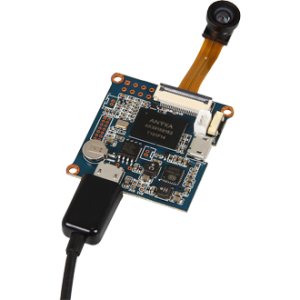
The BPI-D1 is the smallest open-source development board around, with a built-in HD mini camera. At 36mm (w) x36mm (l) and weighing in at 10g, it’s much smaller and lighter than any mini-cam or camera board out there. It allows you to create and customize your own mini-cam and can be a valuable part of any cool hardware you are working on. The D1 prides itself on providing high-resolution image quality: Both video and photos are captured at 1280x720p with a video capture rate of 30 fps.
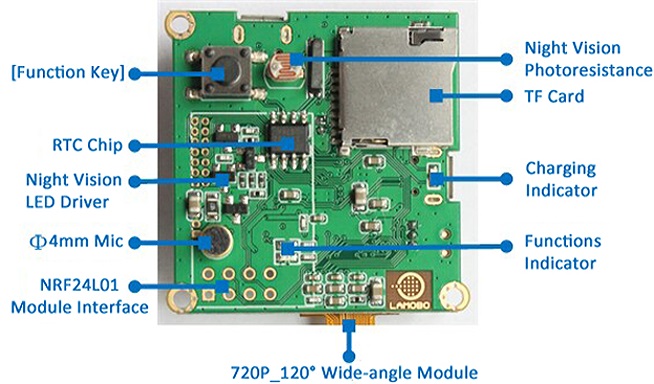
The BPI-D1 is designed specifically to give you all the multimedia tools you need in one small package. Simply connect to an external battery source (with your desired power capacity), and the D1 does the rest: there’s a HD mini-cam, audio sensor, microphone, CPU, GPIO, WiFi, and more – you name it, the D1 has it.
Hardware Specifications
| Size | PCB 38 x 38 mm |
| CPU | 400 MHz ARM926EJ 32 Bits RISC Core |
| RAM | 64 MB DDR2 |
| Flash | 16 MB SPI-Flash |
| Storage | Micro SD Card Seat, supportable for 8G, 16G, 32G TF cards |
| CMOS | CMOS Image Sensor SoC30FPS@720P, Visible light with 940 nm two-way infrared lens filter, with infrared night vision function |
| Lens | M7*P0. 35 EFL=3.0mm/F.NO=2.8/View Angle=60° |
| Video | It achieves H.264 hardware encoding at 1280x720p_30fps. 32G TF card can store 120 hours of video data |
| Audio | MP3/WMA/AAC |
| WiFi | USB wifi module support: WiFi module can be switch between the AP and the SLAVE mode, easy to configue the WiFi module: BPi-D1 support WPS mode |
| RTC | RTC circuit and supporting OSD |
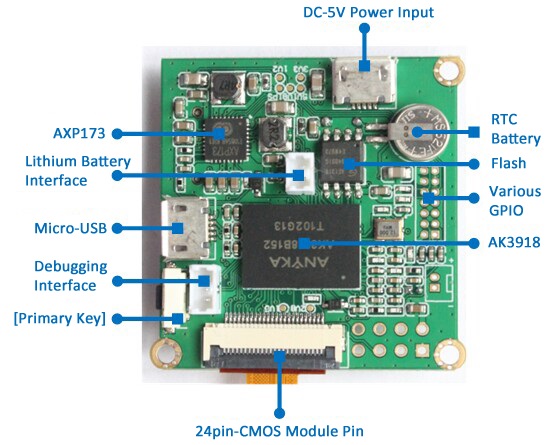
| PM | Support Li-ion charging with built-in AXP173 power management chip |
| Mic | Embedded electrets microphone |
| Power | Recording: 5V-200mA, WiFi on: 5V-350mA |
| Consumption | Continuosly record 720p video or audio data for 24 hour when a mobile power of 10000 mAh is available. |
| GPIO | 1UART/2GPIO; 2PWM/2GPIO; I2C; Audio Line IN; HP Audio Out L; HP Audio Out R; 1SPI Interface |
| UART | Independent UART debugging interface |
| USB | USB programmatic interface / OTG device (WiFi module / USB drive) |
| DC IN | Micro-USB single +5V power input |
| Battery | 3.7V Li-Ion Socket |
| OS | Running on Linux 3.4 35, Kernel Operation system that makes secondary development possible |